
How to Reduce the Mental Load With One Simple Shared Shopping List
Sep 28, 2026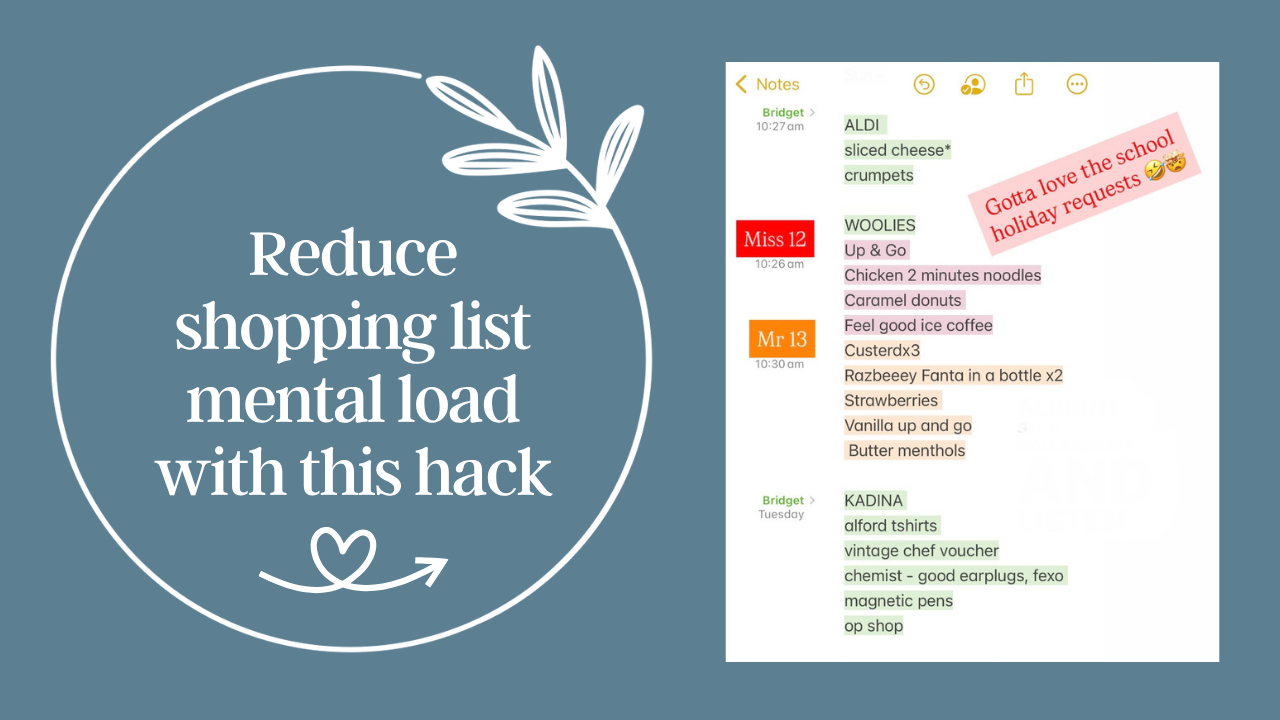
If you are the person in your family who somehow knows there are only two slices of cheese left, someone finished the toothpaste yesterday, the kids need more Up & Go before Monday and there is approximately half a teaspoon of milk left in the fridge, you are probably carrying more than the shopping list. You are carrying the mental load of keeping the household stocked.
For many families, and let’s be honest, often mums, this becomes one of those jobs we do so automatically that we barely recognise it as work. We notice what is running low, remember what everyone likes, anticipate what will be needed next week, mentally scan the fridge and pantry before shopping and somehow know that the shampoo bottle somebody put back in the shower is actually empty. Then someone asks, “Did you get more cereal?”
One of the simplest systems we use in our house to reduce that load is a shared shopping list in the Notes app. It takes a couple of minutes to set up, doesn’t require another app, and most importantly, shifts some of the responsibility for remembering away from one person.
Our shared family shopping list hack
We have one shared note that everyone in the family can access. Mr Farmer and I use it from our iPhones and the kids can access it from their iPads too. Everyone sees the same list and everyone can add to it in real time (even when I'm at the supermarket).
But the actual magic isn’t the technology. It’s the household rule that goes with it: if you use the last of something, YOU are responsible for adding it to the shopping list.
That means I don’t want, “Mum, we’re nearly out of toothpaste,” shouted at me while I’m cooking dinner. I don’t want someone casually mentioning at 8.42 pm that they finished the cereal three days ago and hoping my brain magically files that information away for the weekend shop. If you finish it, notice it is nearly gone or want something bought, you add it to the list.
And yes, apparently this also means the kids can add things while I am ACTUALLY standing in Woolies.
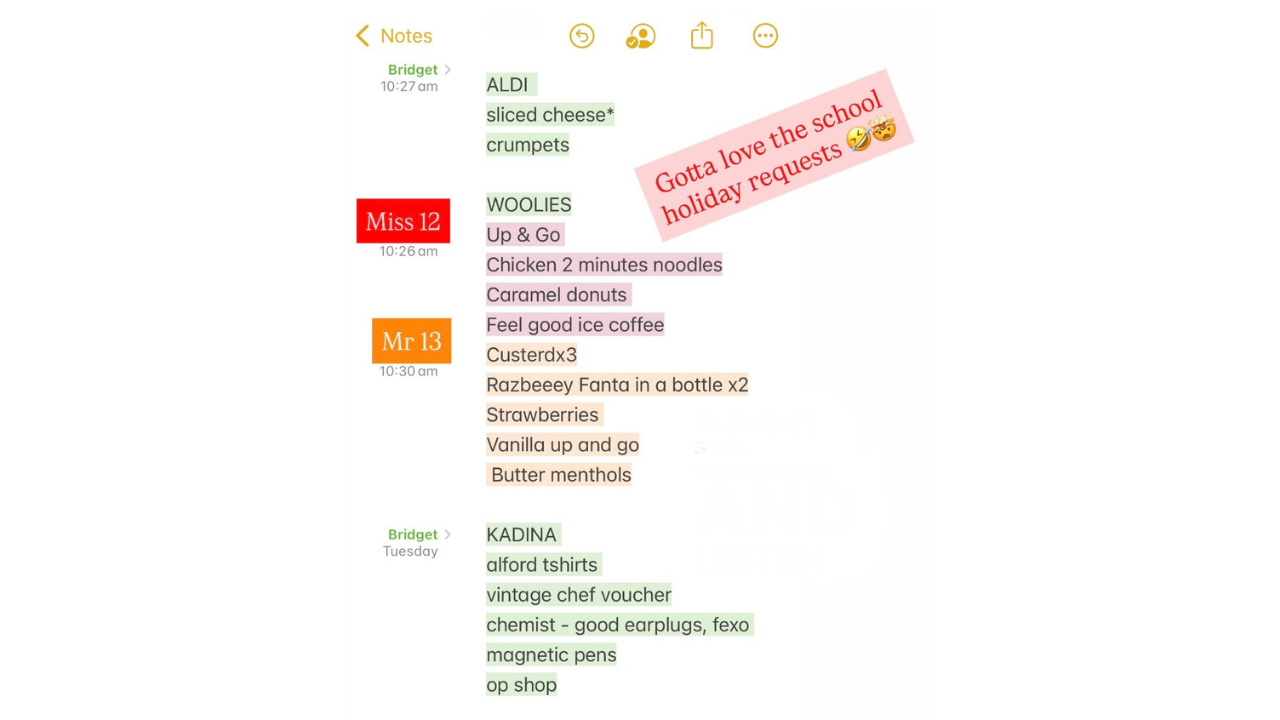
Our actual family shopping list. As you can see, the school holiday requests may stretch the definition of “essential grocery item”.
Why this tiny system helps reduce the mental load
The real benefit isn’t that we are less likely to run out of milk. It is that I am no longer automatically responsible for noticing, remembering and recording every single thing the household needs.
There is a big difference between somebody helping with a household task and somebody owning part of it. If another family member tells me we need toothpaste and I then have to stop what I’m doing, remember where my phone is, open the list and add toothpaste, I am still managing the process. They have simply handed another piece of information to me to carry.
When they notice the toothpaste is nearly gone and add it themselves, that whole little mental loop can happen without involving me at all. It sounds ridiculously small, but the mental load is often made up of hundreds of ridiculously small things. We need cereal. Someone needs shampoo. There isn’t enough fruit for lunches. The dogs are nearly out of food. Somebody needs something from the chemist. We need wrapping paper for Saturday. Individually they are tiny. Collectively, they create a brain that is constantly keeping tabs open.
That is why I love these little household systems. They don’t just make the task easier. They change who is responsible for holding the task in their head.
A Full Life, Made Lighter
This is exactly what I mean when I talk about A Full Life, Made Lighter.
I don’t want an empty life. I actually love having a full one. I want family, work I care about, farm life, community, travel, adventures, friends, projects and ridiculous little moments that make life fun. My goal has never been to remove everything from my calendar so I can sit in a perfectly decluttered house with nothing to do.
What I do want is to stop unnecessarily carrying things that other people are perfectly capable of carrying themselves.
Making life lighter isn’t always about doing less. Sometimes it is about sharing more. Sometimes it is putting a system around something that currently lives only inside your head. Sometimes it is outsourcing something, simplifying it or deciding you don’t need to do it at all.
And sometimes it is simply deciding that the person who eats the last crumpet can put “crumpets” on the shopping list themselves.
That is the question I keep coming back to in my own life: Does this actually need to be mine? Could it be simplified? Shared? Dropped? Outsourced? Handed back to the person it belongs to?
A shared shopping list isn’t going to revolutionise your entire household, but it might remove one recurring job from your brain. Then you find another little thing. And another. That is how a full life starts to feel lighter.
Set it up before your weekend meal planning
If you normally meal plan or do the food shopping on the weekend, Thursday or Friday is actually the perfect time to start this. Create the shared note now, add the people in your household and give everyone a few days to get used to putting things on it before you do the next shop.
For Apple families, simply create a note called something obvious like “Shopping List”, use the collaborate option to share it with everyone, then explain the new rule. If you finish something or notice it is nearly gone, you add it. When it is time to meal plan or shop, the list already contains much of what your household needs rather than you having to recreate it all from memory.
The important part is resisting the temptation to continue managing the shared system for everyone. Otherwise you very quickly end up with a shared shopping list that Mum still has to remind everybody to use, check, update and manage, which rather defeats the purpose.
You don’t need to be an Apple household either. Use whatever simple shared list or notes function your family already has access to. The app isn’t the point. Shared ownership is.
Use what you already have
There are plenty of fancy meal planning and shopping list apps available, and some of them are brilliant. But I am a huge fan of using what you already have before introducing another system into family life.
Every new app can mean another login, another notification, another thing everybody has to learn and another system that quietly becomes one person’s responsibility to maintain. The humble Notes app works for us because we are already using it.
We also use shared notes for birthday and Christmas wish lists, which has become particularly handy now the kids can add their own ideas and website links rather than expecting me to remember some random thing they mentioned three months before their birthday.
Although, judging by what occasionally appears on Miss 12’s list, providing direct access may have created an entirely different problem.
One less thing to remember
Reducing the mental load doesn’t have to begin with a massive family meeting, a colour-coded household management system or completely restructuring who does every job in your house.
Start by noticing one tiny recurring thing that lives in your head simply because it always has. Then ask whether there is a way to stop being the only person responsible for noticing, remembering or managing it.
For us, the family shopping list is one of those tiny changes. It takes almost no effort, but it means I am no longer the sole household inventory system.
And that is what A Full Life, Made Lighter looks like in real life. Not doing everything more efficiently so you can squeeze even more in, but making deliberate choices about what you carry, what you share and what you can finally put down. Because a full life doesn’t have to mean carrying it all.
Want some help making your own life lighter?
This shared shopping list is just one tiny example of what I mean by A Full Life, Made Lighter. You don’t need to overhaul your whole life at once. Start with one thing you can simplify, share, drop or do differently, then build from there.
If the mental load in your house feels much bigger than the shopping list, read what more than 300 women told me about mental load, clutter and overwhelm next. You might recognise yourself in their answers, and you’ll find more ideas for creating systems that don’t rely on Mum remembering everything. Read the Mental Load Survey results.
If your mental load feels a lot bigger than the shopping list, explore my 1:1 support. We can look at what you’re carrying, what actually needs to stay yours, and what you could simplify, share, drop or do differently.
Because you don’t need an empty life. You can have a full life, made lighter.
Wanting more ways to simplify your life? Why not reach out to Bridget and learn the different ways she can support you?
Join the Be Simply Free mailing list
I adore supporting overwhelmed women save time & money by decluttering & simplifying their homes, calendars & minds.
Get free tips straight to your inbox by entering your name and email below.
